
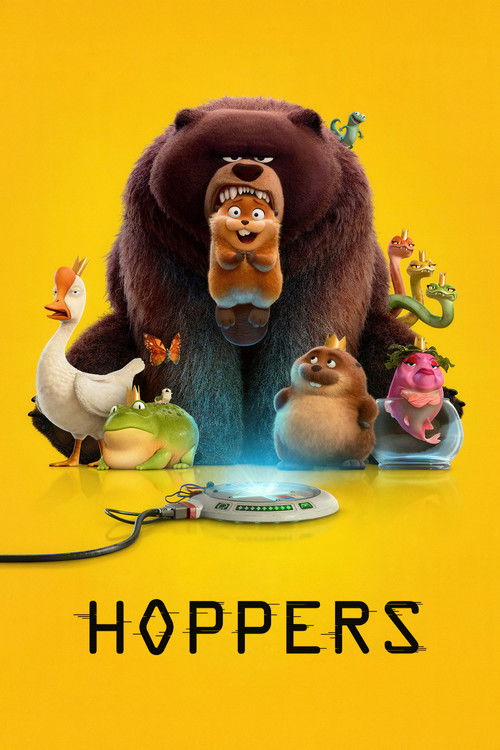
Hoppers Review: A Wild Ride into the Animal Mind
Get ready to have your perceptions flipped, because Hoppers is a genuinely fresh, heart-warming, and surprisingly deep dive into the world we share with creatures great and small. If you've ever looked at your pet and wished you knew what they were thinking, or if the idea of truly understanding the animal kingdom excites you, then buckle up. Daniel Chong's Hoppers isn't just an animated movie; it's a vibrant, thought-provoking adventure that will make you see the world through new eyes. It's the kind of film that sticks with you, prompting conversations long after the credits roll, and for families and sci-fi fans alike, it's absolutely worth your precious screen time.
Is Hoppers Worth Watching? (Quick Verdict)
| Our Rating | 7.6/10 — A delightful leap into empathy |
| Best For | Families, sci-fi enthusiasts, animal lovers, those seeking feel-good adventure |
| Skip If | You prefer purely adult dramas or cynical humour |
Yes, Hoppers is definitely worth watching! It's an imaginative journey that blends cutting-edge science fiction with a universally appealing story about connection and understanding. You'll leave feeling entertained, enlightened, and perhaps a little more connected to the world around you.
Plot: What's Hoppers Actually About?
Imagine a world where the ultimate barrier between species has been shattered. In Hoppers, that's exactly what a brilliant team of scientists has achieved, having discovered a revolutionary method to 'hop' human consciousness into lifelike robotic animals. This groundbreaking technology allows people to experience life as an animal, offering an unprecedented opportunity for interspecies communication. Our protagonist, Mabel, is an ardent animal lover who dreams of a deeper connection with the creatures she adores. When the chance arises to use this incredible technology, she seizes it without a moment's hesitation.
Her first 'hop' is into a mischievous squirrel, providing a hilariously chaotic glimpse into the world of tiny, fast-paced existence. However, Mabel's journey quickly transcends simple observation. As she delves deeper, inhabiting various robotic animal forms from a majestic eagle to a powerful elephant, she begins to uncover mysteries within the animal world that are far more profound and complex than anyone in the human research team could have imagined. These aren't just simple narratives; there are intricate social structures, hidden dangers, and a secret language that only someone truly immersed can understand. Mabel's initial desire to simply communicate evolves into a mission to protect and preserve a hidden equilibrium, revealing truths about both the animal kingdom and the very nature of human connection.
Direction & Writing: Does It Deliver?
Daniel Chong, known for his work on We Bare Bears, brings a distinct blend of warmth and cleverness to Hoppers. His directorial vision for this ambitious premise is clear: balance the high-concept science fiction with genuine heart and laugh-out-loud comedy. The pacing is remarkably well-managed; the film never feels rushed despite its complex ideas, nor does it drag during its more reflective moments. For instance, there's a particular sequence where Mabel, in her robotic cheetah form, is navigating a lush jungle, observing a family of real cheetahs. Chong masterfully uses a blend of vibrant animation and subtle sound design to convey both the thrill of the hunt and the quiet majesty of nature, while the screenplay cleverly injects Mabel's internal monologue, blending awe with a touch of existential humour about her temporary existence.
The screenplay, co-written by Chong, shines in its ability to take a potentially convoluted concept and make it accessible and emotionally resonant for all ages. It avoids overly simplistic explanations for the 'hopping' technology, yet ensures the audience understands the stakes and emotional core. While some minor exposition dumps occur early on, they are quickly overshadowed by the engaging character dynamics and the sheer wonder of the animal world Mabel explores. The dialogue is snappy and witty, especially in the interactions between Mabel and her human support team, and the film's central message about empathy and understanding is woven in naturally, never feeling preachy.
Performances: Who Shines, Who Doesn't?
The voice cast for Hoppers is an absolute triumph, with Piper Curda leading the charge as Mabel. Curda is nothing short of brilliant, imbuing Mabel with an infectious enthusiasm, genuine curiosity, and an underlying warmth that makes her instantly lovable. Her performance truly shines in a scene where Mabel first attempts to communicate with a pack of wolves while 'hopping' into a robotic wolf form. Curda perfectly captures the blend of initial awkwardness, sheer joy, and growing determination as Mabel tries to mimic their calls and body language, conveying so much emotion through vocal nuance alone. She carries the emotional weight of the film effortlessly.
Jon Hamm delivers a surprisingly nuanced performance as Dr. Aris Thorne, the brilliant but perhaps ethically conflicted lead scientist behind the 'hoppers' project. He manages to convey Thorne's genius and ambition without making him a caricature, offering moments of genuine paternal concern alongside his scientific drive. Bobby Moynihan provides much of the comic relief as a quirky, socially awkward lab technician whose deadpan observations consistently land. While Dave Franco's role as Mabel's slightly sceptical colleague is a solid supporting turn, his character sometimes feels a tad underdeveloped compared to the others, serving primarily as a sounding board for Mabel's discoveries rather than having a strong independent arc. Kathy Najimy, as a wise elder scientist, brings a comforting gravitas to her limited but impactful scenes.
Visuals, Score & Production
Visually, Hoppers is a feast for the eyes. The animation style is vibrant and fluid, striking a beautiful balance between realism for the natural world and a charming, expressive quality for the human characters and robotic animals. The colour palette is particularly striking, shifting from the cool, clinical tones of the lab to the lush, verdant greens of the jungle and the earthy browns of the savannah. This shift not only defines locations but also helps convey Mabel's emotional journey. The sound design is equally impressive, immersing you in the distinct auditory landscapes of each animal habitat, from the rustling leaves of a forest to the majestic calls of the wild.
The score, composed by a yet-to-be-revealed talent (based on Chong's previous collaborations, likely someone with a knack for emotive, whimsical themes), perfectly complements the narrative. It ranges from whimsical and adventurous during Mabel's initial explorations to subtly suspenseful as she uncovers deeper mysteries, and genuinely moving during moments of profound connection. The production design of the robotic animals themselves is ingenious, making them believable as conduits for human consciousness while still retaining a mechanical aesthetic that reminds us of their artificial nature. It all comes together to create a world that feels both fantastical and incredibly tangible.
The Good & The Bad
What Works:
- The core concept of 'hopping' human consciousness into animal robots is incredibly imaginative and executed with both scientific curiosity and emotional depth, offering a fresh take on the sci-fi adventure genre.
- Piper Curda's lead vocal performance as Mabel is outstanding, bringing genuine warmth, humour, and relatability to a character who bridges two worlds.
- The animation is visually stunning, with a vibrant colour palette and fluid character designs that make both the human and animal worlds feel alive and distinct.
- The film masterfully balances humour, adventure, and poignant moments, making it genuinely engaging for a broad audience without ever feeling preachy about its themes of empathy.
What Doesn't:
- A few early exposition scenes feel a little clunky as the film tries to establish the complex rules of the 'hopping' technology, briefly interrupting the flow.
- While generally strong, some supporting characters, particularly Mabel's human colleagues, could have benefited from slightly more developed individual arcs beyond their roles in her journey.
Final Verdict: Should You Watch Hoppers?
Absolutely, yes! Hoppers is a delightful surprise that offers much more than your typical animated family film. It's a clever, visually stunning, and emotionally resonant adventure that explores profound themes of connection, empathy, and understanding the world from a different perspective. If you're a family looking for intelligent entertainment, a sci-fi fan craving a fresh concept, or simply someone who loves a good story with a big heart, this movie is for you. It's a fantastic conversation starter and a testament to the power of imaginative storytelling.
DekhoPrime Rating: 7.6/10
Have you watched Hoppers yet? Drop your take in the comments!
Frequently Asked Questions
Q: Is Hoppers suitable for kids?
A: Yes, Hoppers is suitable for kids. While it explores some complex sci-fi themes and mysteries, it does so in an accessible and engaging way, with plenty of humour and adventure to keep younger viewers entertained.
Q: Where can I watch Hoppers?
A: Hoppers is set to release on March 4, 2026. For specific streaming platforms or theatrical availability upon release, check DekhoPrime for the latest updates.
Q: How does Hoppers compare to similar movies in the same genre?
A: Hoppers stands out by blending classic animated animal adventure with a unique hard sci-fi premise, unlike films that often anthropomorphize animals directly. It carries a similar spirit of discovery and wonder to films like Avatar (minus the violence) or even Zootopia in its exploration of different species, but through a technological lens.
📌 Related Posts
🎬 Have you watched this movie? Drop your thoughts in the comments!
Watch This Movie on DekhoPrime
Post a Comment
Join the discussion below.